Showing posts with label Leadership. Show all posts

Sunday, August 3, 2014

4 Leadership Principles from Tim Howard


It has been almost two weeks since Germany was crowned the 2014 World Cup Soccer Champion. For me, one game stood out and has inspired me in life and business. 

Belgium vs USA

Tim Howard Leadership Principles

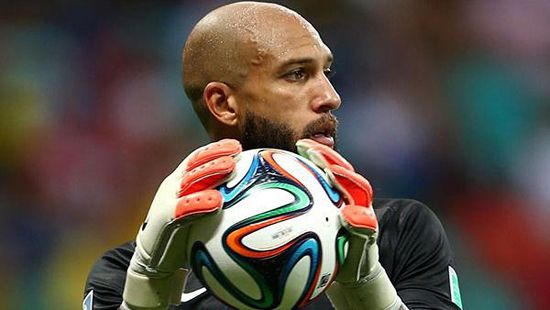
Tim Howard, American goal keeper, faced a never-ending Belgium onslaught for 120 minutes. Howard tallied an amazing 16 saves, the most in World Cup history. 


Even though the United States ended up losing the round of 16 match, Tim Howard quickly became a nation's hero. 


I could really tell that he was in the zone and that he really wanted to win. He was courageous and humble during the whole match. This attitude is crucial to succeed in life and business.

So how did he do it? How did Howard have the game of his life?


4 Leadership/Success Principles

Let me try to keep it simple and say that he applied a few success and leadership principles

1. Consistent Hard Work, Every Day


Nothing happens without hard work. The moments leading up to the zone or having the best game of your life, first start with learning and applying the principles of success. Not just for one day, but day in and day out, rain or snow. 

My favorite quote is, "To perform like a champion, you must practice like one." Consistent hard work focused on the right principles set Tim Howard up for his amazing world record game.

2. Lift Where You Stand
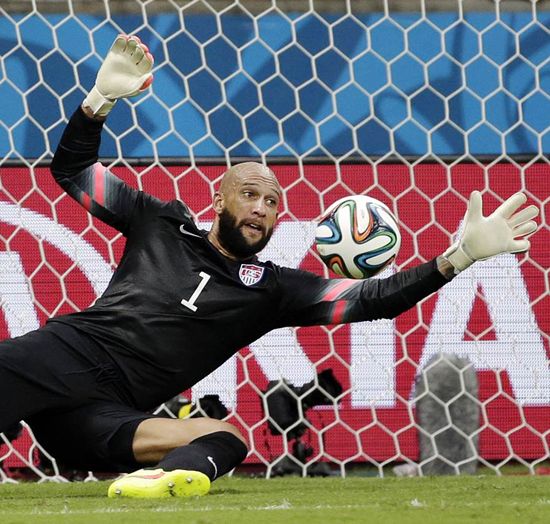

With 16 saves, I saw Tim Howard apply the principle of lift where you stand. This is a simple principle. Give it your all in the area you've been assigned. 

It's easy to point out how others are not doing it right or how they could be doing their job better. The lift where you stand principle was in full effect for Tim Howard. Each time it was his turn or in his area he made sure he lifted and lifted hard.

3. Quickly Align Team Members (Players)


Being a successful leader is helping every member of your team be positioned in the right area at the right time. Tim Howard did this awesome. I could see him quickly point and shout out positioning statements with his team. Once everyone was aligned in the right place, it gave Howard the right angles to be successful and save goals. 

4. Show by Example


This is simple. Be the person you say you are and show it by your actions. Tim posted this on his Twitter. 
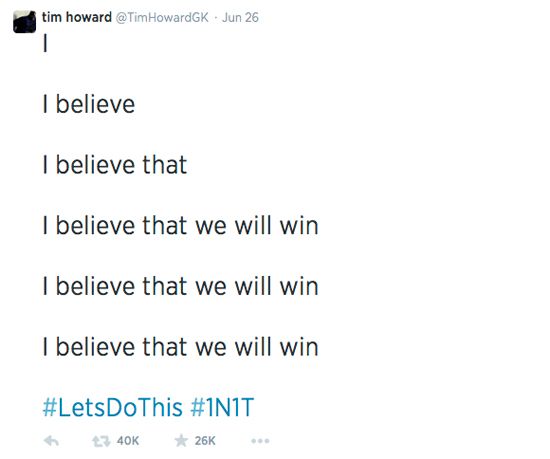


As Howard entered the field, you could see that he was determined to win. During the game, he gave it his all. This translated into energy for other members of his team. Energy can make or break performance.

There you have it, the four success/leadership principles Tim Howard applied to have one of the best games of his life—world cup record  in goal keep saves.

It you liked this article you can also read:

4 Principles to Put Yourself in Position to Win

If you want to receive real-time alerts on blog posts you can subscribe to my RSS feed here.

You can also follow me on Twitter here.

Thursday, July 17, 2014

4 Principles to Put Yourself in Position to Win


Tonight I had the opportunity to listen to, six time Olympic medalist and champion, Jackie Joyner-Kersee as part of the National Athletic Institute speed camp kickoff event. I grew up cheering her on. She is a true champion with a story that inspires each of us to believe anything is possible.


Put Yourself in Position to Win

During her keynote, she said a profound statement, "Put Yourself in the Position to Win." This she explained, was a state of mind, an attitude—as much mental as physical. 


She explained how the 1984 Olympics really drove this point home. Even though crowned with an Olympic medal she felt as if she had much more to give and was personally disappointed with her performance. 

Like any great athlete, Jackie learned from her mistake and would change her approach to training in preparation for the 1988 Olympics in Seoul. It paid off and she won Olympic gold in the Heptathlon and Long Jump. 

4 Principles to Win 

Her success, she mentioned, was due to applying four principles. Each of us can apply these and win.

1. Be a Little Better Each Day


Jackie said, "I wasn't the fastest day one. I had to work a little harder each day. I knew if I didn't, another competitor would. I knew as my legs burned that I was improving and becoming better. This is how I really began to grow as a world-class athlete." 

2. Mind Over Matter

Jackie said, "I really had to learn to compete. Not just how to compete physically, but how to compete mentally." I agree with this, it really starts with our attitude. How we approach each day, each challenge, will largely determine if we have the capacity to win.


3. Learn Your Pace

Jackie said, "You must learn your pace. Many athletes would start out fast and slow down at the end. Other athletes would start slow and turn on the kick toward the end of the race. For me it was always knowing my pace. If I trained hard enough than my pace would be good enough to win." 

4. Be the Ultimate Decision Maker

Jackie said, "Many people make excuses for how the day is going or why they are failing. Each of us are the ultimate decision maker of our day. We each need to believe in ourselves. You should never put your self in second place. You need to go out to win. A big part of this is having the right mental state of mind, so the physical can really kick in high gear."

I think each of us can really benefit from Jackie Joyner-Kersee four principles to position ourselves to win. It was a privilege to listen to her speak. 

I also got to take pictures of her as she spoke tonight. These pictures I have highlighted in this blog post.

If you like this article you might also like:

3 Ways to Reenergize Your Life

You can follow me on twitter here

Saturday, April 26, 2014

7 Steps to Increase Personal Productivity


I'll start with one question about your business work day, "How many hours do you work uninterrupted? 


Productivity Killers

When I mean uninterrupted, I am not just talking about people who may stop by your office or desk looking to chat, collaborate, or just ask an important question. 

There are other distractions or productivity killers that can cause each of us to lose our productivity, distract us, drain our energy, and make use feel like we are running around in circles.

Here are a few productivity killers to watch for:

1. Email
2. Checking social media
3. Unplanned drive bys
4. Doing non important tasks

7 Steps to Increase Personal Productivity

Lets start here. 

Just imagine a day with 3 hours of uninterrupted work. Just imagine the focus and progress you would make that day.

In an article by David Franzen in this month's Content Marketing Magazine, Franzen explains 7 steps to achieve personal productivity and high performance.

Franzen first explains three important elements that need to be present to achieve productivity.

1. Clarity
2. Organization
3. Systems

Below are Franzen's 7 steps that will help you achieve better personal productivity at work.

1. Clean Your Desk

Your desk should be reserved solely for the few items that your are currently working on. Place everything else out of your field of vision.

2. Separate Projects Into Folders

This can be physical or digital. The key is to focus on one thing at a time.

3. Keep a To-Do List

Keeping a to-do list with items prioritized based on importance keeps your brain focused. This way the next action you should take is always right in front of you. 

4. Do Your Most Important Task First

Making progress or completing a high priority task is vital to productivity. It sets the stage for the rest of your day. You will also tackle it with the most clarity and energy.

5. Do Not Check Email, Facebook, Instagram, or Twitter

If doing the most important thing first is setting yourself up to win, checking emails or any social media is setting yourself to lose. Don't do it. You brain will go into instant distraction mode.

A better strategy is to designate a specific period of time each day to reading and checking emails. 

6. Eliminate Distractions and Interruptions

When you're working, you should shut off the sounds of email, tweets or Facebook messages. Imagine hanging a "Do Not Disturb" sign on the door of your mind. Mentally you can  achieve a high level of focus by setting clear start and stop times for your work sessions.

7. Eat, Move, Sleep, or Suffer the Consequences

Recent studies have shown that eating at the right times, moving (walking, running or just getting in motion), and getting enough sleep daily help to invigorate your life with energy, creativity, and clarity—which are three important things to be more productive.

Get started today and get in the productivity zone more often—get more of the right work done at the right time.

If you liked this article you may also like

3 Ways to Reenergize Your Life

Tuesday, March 4, 2014

3 Ways to Reenergize Your Life


As a business leader or athlete energy is crucial for success. Life has some ups and downs that can drain your energy. Here are three ways to reenergize your life.

3 Ways to Reenergize Your Life


1. Exercise

This is simple—get in motion. There are tons of medical studies that show the importance of exercising. It sounds counterintuitive, but the results are amazing. Start now and you'll see the difference. You'll have more energy, be more creative, solve problems better, sleep better, you'll increase your self confidence, and you'll be more healthy. You'll find ways to confront and overcome any challenge. Creating this habit in your life will pay off huge. You'll reenergize your life.

2. Serve Others

I know of no better feeling then serving others. Helping others succeed is one of life's greatest gifts. It brings with it tons of positive energy. If you're feeling down, start looking for someone to help or serve. Each day people are in need of help, whether you give someone a smile, a confident pat on the back, or just a nice compliment—you'll reenergize their life and yours.  

3. Be Grateful

Focus on the positive of life. What are you grateful for? I know the storms of life hit each of us and it seems like there is nothing to be grateful for. Start with a simple list. What are the good things that are going on in your life? If you think about it enough, you'll find many things to be grateful. This exercise daily will reenergize your life. 

There's so much good for you to do in the world and you'll need energy to do it. There are people waiting for your positive influence. If you are feeling down, try these three things. One thing I promise—you'll find energy and you'll find your purpose.

Never give up

Learn more about my philosophy here

If you like this post you may also like:

Surround Yourself with Believers

Thursday, November 21, 2013

Two Success Factors - Persistence and Determination


One of my friends recently shared a quote with me from Calvin Coolidge.


Coolidge said,

"Nothing in this world can take the place of persistence. Talent will not; nothing is more common than unsuccessful people with talent. Genius will not; unrewarded genius is almost a proverb. Education will not; the world is full of educated derelicts. Persistence and determination alone are omnipotent. The slogan "press on" has solved and always will solve the problems of the human race."

I agree with Coolidge. I believe success in life comes down to these two success factors—persistence and determination. It's always the last 10 yards that are the hardest. It's always the extra effort that helps us discover our real potential. It's always the storm before the calm that makes the sunshine meaningful. So many people come so close only to lose the prize because of persistence. 

Two Success Factors

I think it's important to define these two success factors to really understand what it takes to be successful.

Persistence: 

  • Refusing to give up or let go
  • Insistently repetitive or continuous
  • Existing or remaining in the same state for an indefinitely long time; enduring tenaciously
  • Lasting without falling off
  • Retained permanently, rather than disappearing in a early stage
  • Occurring without interruption

Determination:

  • Firmness of purpose; resolve
  • Resoluteness
  • Never giving up, never
  • Unshakeable resolution to finish
  • Controlling the outcome
  • Fixed and firmly held

Now it's up to each of us. 

What goals are you currently working on that will require real persistence and real determination. Think of those goals and write down your plan to "press on" and finish what you've started. 

This is not for some of us. It's for all of us.

#nevergiveup

Follow me on Twitter here
Learn more about my life philosophy here

Wednesday, October 23, 2013

Build a Culture of Learning

Many of the most successful companies in the world establish cultures of learning. What do I mean?


It's simple. Just apply what you learned during your seventh grade science project—start with a hypothesis. What do you want to learn about your customer? What do you want to learn about your business? What are the do's and the don'ts? How do you create the best experience possible? 

Everyone Learning

Start by having each department of your business focus on  learning. What are they currently learning and what do they want to learn?

These questions are easily answered with experiments. Once you get enough data to make the experiment valid, record what you learn, apply it, and move on to the next learning.

Have each department report on what they are learning. You can do this on a weekly basis. Too many times I've seen companies learn something really important and forget to really learn it, so they do it again—the same costly mistake.

Use your learnings to your advantage. I like to write them down in a google doc so I can share them with other members of my teams. We ask ourselves, "Now that we know this, what are we going to do about it?"

You will be surprised by all the important learnings your team makes if you establish a culture of learning.

Some of the top business leaders in the world take this advice to heart. Here are some important learning from the world's top business leaders.

Top Learnings

Weigh Your Priorities

"Most start ups are focused on growing faster. That alone would not make us a great company. We realized we had to focus on three things: love, growth, and foundation." 

Brian Chesky, CEO, Airbnb

Celebrate Each Step

"The best way to make employees happy is to set realistic goals and achieve them. I make sure those small steps are pointing us in the right direction."

Leila Janah, CEO, Samasource

Get Better As You Get Bigger

"We grew like crazy in 2012, but we had a lot of growing pains. Make sure your structure is efficient before piling more people on top of it."

Ben Lerer, CEO, Thrillist

Entrepreneur is a Job Title

"Entrepreneurship is a new corporate function. If companies are looking to have teams build new disruptive innovations, each team should have a leader whose business card says "entrepreneur."

Eric Ries, Author, The Learn Startup

Overcommunicate, Overcommunicate

"Ideas go nowhere if they stay in your head. Everything has to be communicated to the people who execute the ideas."

Dennis Crowley, CEO, Foursquare

Data Trumps Opinions

"The highest-paid opinion matters the least. Data from experiments is critical so that the best idea can prove itself."

Brad Smith, CEO, Intuit

Don't Skimp on Talent

"This year was all about having the conviction that when you hire great people, despite the cost, great things will happen."

Jonah Peretti, Co Founder, BuzzFeed

Don't Overcommit

"The commitments I make don't affect only me. Next year I'll set more realistic goals for my company so our employees can have a healthy work-life balance."

David Chang, Chef and Founder, Momofuku

Assemble a Dedicated Team with a Shared Vision

"Commitment to the vision trumps funding, technology, gold-plated degrees, and press. It remains our primary qualification. Everything else can be taught."

Marci Harris, CEO, Popvox

Focus on Collisions

"Innovation is often the result of random conversations, collisions—where ideas outside your industry are applied to your own. We want to accelerate those collisions among our people."

Tony Hsieh, CEO, Zappos

Users Deserve An Roi

"When you put your information about yourself out there, that's a transaction. You need to feel that your getting something in return."

Margaret Stewart, Director of Product Design, Facebook

You can see the power of learning. Just imagine what you will learn if you focus on it. Build a culture of learning.

Follow me on twitter here—to receive real-time insights about high-performance business.

Learn more about my business philosophy here.

Tuesday, October 15, 2013

Surround Yourself with Believers Part 2 of 2


Blog post two of the series, "Surround Yourself with Believers". You can read my first blog post in the series here. 


Our Life Mission

Our mission in life should be to discover our talents. Each of us have been given a unique set of talents and skills. Our personality combined with our talents make each of us unique. The combination makes each of us great. After we discover our talents we need to align them with our passions. Our talents aligned with our passions will guide our life, give us fulfillment, and help each of us live our life mission. 

The next important step—surround ourselves with believers. Those who know our skills, our talents, and who we will become if we are patient, work hard, and believe.

Henrik, You Got This

A prefect example of this occurred behind the scenes at the 2013 X Games in Aspen Colorado between Tanner Hall and Henrik Harlaut.

Let me set the stage. Henrik was in first place at X Game Big Air competition. As he walks up to do one of his final jumps he gets a pep talk from Tanner Hall. Tanner understands Henrik talents and skills. The result was powerful. 

Watch the clip to see how important it was for Henrik to surround himself with a believer—Tanner Hall. 


But I Can Win Without It.

To me one of the most game changing lines was when Henrik says, "yeah, but I can still win without doing it." Tanner's response,  "I know you can do this, you got this! Believe in yourself, believe in your skill. You know exactly what your are doing. Let's put it in the history books. Let's take skiing to the next level!" The right response from a believer.

The Power

As you watch the video, you can see the words start to have an impact on Henrik. He even smiles back at Tanner. As Henrik gets ready to take his run you hear Tanner say, "You got this son!" 

Henrik skis down and does the world's first ever Nose Butter Triple Cork 1620 and claims the gold medal. I watched this live on TV and it was incredible. To listen to the words of Tanner to Henrik minutes before the trick was inspirational.

The Key

In life each of us will have naysayers. There will be those who don't care to understand our skills, our potential,  or what we will become. Don't waste your time with them. Discover your talents, align them to your passions, and surround yourself with believers. We are all meant to do great things.   

"You got this son!"

Follow me on twitter here—to receive real-time insights about high-performance life.

Learn more about my philosophy here.

Monday, September 23, 2013

Drive Strategy to Ownership to Execution


The power of strategy is found in execution. Many of the best strategies and plans fall flat without great execution. I have found that strong execution comes from empowerment and ownership of team members at every level and in every department.

Two Ways to Drive Strategy to Ownership to Execution


In this blog post, I will explain two simple ways to drive strategy to ownership to execution. 

1. Define the end goal
2. Know where you want to arrive

Commander's Intent

I've been reading the book, "Made to Stick" by Chip and Dan Heath. In the book they explain a concept called commander's intent. I think there is a lot to learn from the commander's intent concept. 

Let me explain it. The Army, Navy, and Air Force build extension plans and strategies. Each plan and strategy contains extensive detail—when, where, what, who. These details are then sent to every military level to prepare for its execution.

In the 1980's, they recognized a roadblock to this process. They found that even after a detail plan was in place, it would change within seconds on the battlefield. No plan survives contact with the enemy. So they built a process called commander's intent

1. Define the End Goal

Commander's intent (CI) is simple. Instead of the trying to plan out everything. CI starts by asking what is the end goal? This is a simple statement. It's very clear. Each tactical level then builds their own CI. Now it's very clear the strategy to execute. Without detailed plans, CI gives complete trust and ownership to those who execute. This is the key to successful world-class execution of strategies and plans.

You can see how this would apply to a business. Each department head, manager, and front line worker would clearly understand the end goal and build their own CI to align perfectly to the strategy. They are given liberty to come up with the appropriate solution or execution path to best achieve the end goal. This promotes leadership growth and one of the greatest gifts you can give an employee, ownership. The ability to put their mark on the business.

2. Know Where You Want to Arrive

To arrive at the proper commander's intent. You can ask yourself two simple questions.

1. If we do nothing else tomorrow we must...
2. The single most important thing we can do tomorrow is...

If the CI or strategy is clear, it should be easy to answer the above questions. If not, spend more time collaborating with your teams until it is very clear where you want to arrive. 

It should be very clear and simple. Now let your teams take ownership of the game plan or path to execution. You will be surprised what they come up with. This is where trust and onwership come in. This is where the world-class execution comes from. 

These two simple ways will help your business drive strategy to ownership to execution—creating an impressive culture and building future leaders.

Follow me on twitter here—to receive real-time insights about high-performance business.

Learn more about my philosophy here

Sunday, April 14, 2013

Surround Yourself with Believers Part 1 of 2


What do I mean?

In our lives and in our careers we all have managers, coaches, and mentors. Our goal should be to surround ourselves with believers. 


What are Believers? 

Believers are managers, coaches, and mentors who recognize your talents, see your potential, and believe in what you will become. They help coach, manage, and mentor toward greatness, even when you might doubt. 

Believers are critical to success. 

Stay Away from Non Believers 

Life is too short to hang around non believers. Non believers are those who never take time to discover your talents, understand your skills, or even care who you are. These are poor coaches and managers. Non believers are short sided and mostly think of themselves. Do your best to stay clear of these type of people. They will do you no good. And of course, you will prove them wrong 10 times out of 10.

Branch Rickey was a Believer

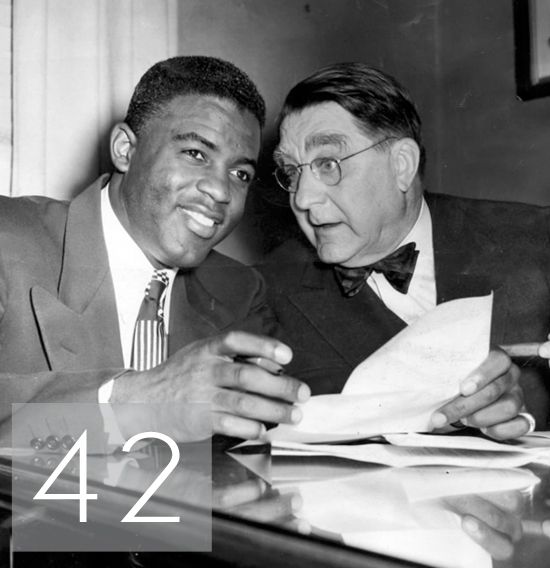
Branch Rickey believed in a young baseball player named Jackie Robinson. 

It was 1943. There was a color barrier in baseball. Branch Rickey did not believe in color. He believed in talents and skills that would produce a winning result. That was his focus with Jackie Robinson. In 1943, Rickey got approval from the Dodgers Board of Directors to begin the search for "the right man".

Rickey recognized Jackie's baseball skills. He also recognized Jackie Robinson's greatest talent, the ability to not fight back even under intense moments of racism.

Jackie Robinson Believed Branch Rickey

In the new movie 42, The True Story of an American Legend, there is a scene with Branch Rickey and Jackie Robinson that exemplifies an interaction between a believer and his student. 

Rickey knew that Jackie Robinson was "the right man", but wanted to make sure he could withstand the storm they were about to create.

During their first meeting, Rickey says, "I want a ball player with the guts not to fight back." Jackie Robinson responds to his statement with, "You give me a uniform, you give me a number on my back, I'll give you the guts."

The Believer Effect

Branch Rickey helped Jackie Robinson believe in what he was about to do. Rickey saw the future. He believed in Jackie Robinson. He knew it was going to be tough, but believed Robinson would do it. 

Rickey was right, right from the start, Robinson faced intense discrimination from players and fans. Robinson would not retaliate and on April 15, 1947 broke the baseball color barrier starting on first base with the Brooklyn Dodgers.

Surround Yourself with Believers

Each of us are meant to do great things in this life. We need to use our talents to change the world, to make it better. We all can do this. Your first step will be to surround yourself with believers. 

Follow me on twitter here — to receive real-time insights about high-performance business and life.


Learn more about my philosophy here

Saturday, April 13, 2013

The Two Truths of Team Management Success


I was talking to Ty Kiisel, a good friend and Forbes writer, about the two truths each manager should know about their team. We have discussed this over many months and have summed it up with two truths.


The Two Truths of Team Management Success

1. Every Team Member Wants to Do a Good Job

No one wakes up in the morning and says, "Today I want to do a bad job." The truth is that every person wants to do a good job. This is where you come in. As a manager, you get to positively or negatively impact that statement daily. 

Start with this. 

Look at each team member with this phrase in mind, "Today, <insert team member's name> wants to do a good job. How can I help them do that?

Then.

Start recognizing the good work each team member does. Be specific with each compliment. You can't just come up and say, "George, good job today." Be specific. "George, thanks for taking the lead on the product launch strategy. Your analysis and recommendations were very clear and spot on. I am excited to execute what you suggest. Awesome job."

Define their job (role) clearly.

The more clearly defined a team member's job or role, the more consistent they will be at achieving a "Good Job". Once again, this is where you come in. Each of your team members should be able to say. "My job today is to <team member inserts what they focus on each day>.  

Truth: Each team member wants to do a good job.

2. Every Team Member Wants to Win

The truth is simple, but very powerful. Each team member comes to work to win. Here is where you come in. 

Start with this.

Look at each team member with this phrase in mind, "Today, <insert team member's name> wants to win". How can I help them do that? Are there any obstacles I can remove to ensure they win?

Then.

Define what a win is. In sports we do this everyday, we clearly define how to get points and how to win. Many times managers forget to clearly define what a win looks like. Not only that, but they forget to teach teams to learn to recognize and celebrate wins. This is key.

Celebrate wins, even tiny ones.

Once your team members understand what it means to win. Start celebrating. Many times wins go unrecognized and uncelebrated. It you want to create a winning team environment teach your team to recognize and celebrate wins, even tiny ones.

Truth: Each team member wants to win.

The Power of These Two Management Truths

As a manager, you are only as good as your team. You can't do everything. You can't be every where, nor should you want to. Winning teams utilize the strengths and talents of their team members. Winning team managers utilize the two truths we discussed above. Remember the two simple truths to team management success:

Every team member wants to do a good job and every team member wants to win.

Follow me on twitter here to receive real-time insights about high-performance business and life.


Learn more about my philosophy here